

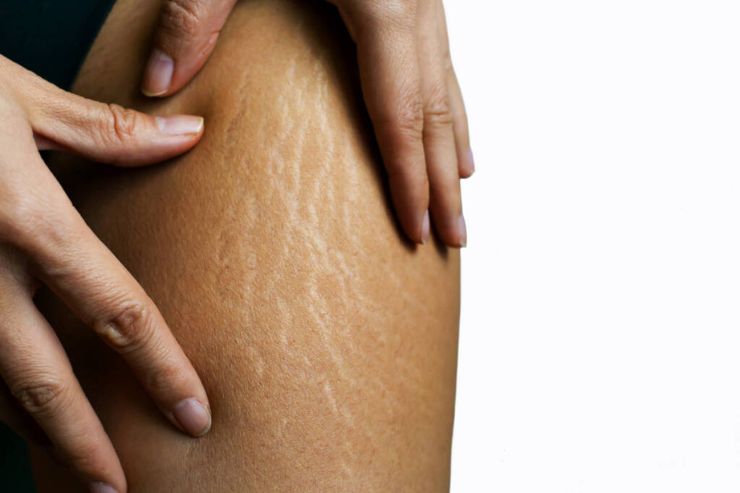
Stretch Mark Revision in New York City
Stretch mark revision at Visage New York Studio uses medical-grade pigment implantation to reduce the visibility of striae from pregnancy, weight changes, growth spurts, or muscle gain. It’s a distinct technique from general scar camouflage. This is because stretch marks form differently and sit in thinner, more delicate tissue than surgical or injury scars.
Our Manhattan studio treats striae rubra (newer, still pink or red marks) and striae alba (mature, white or silver marks). These marks can appear across the abdomen, hips, thighs, breasts, and arms. Pigment is custom mixed for each area based on the client’s undertone and Fitzpatrick skin type.
What Is Stretch Mark Revision and How It Works
Stretch marks form when the skin stretches faster than collagen and elastin can keep up, tearing the dermis and leaving a streak of thinner, differently pigmented tissue. As a result, striae often look pale, shiny, or textured compared to the surrounding skin, even years later.
Stretch mark revision deposits pigment into this thinned dermal layer to reduce the tonal gap between the mark and surrounding skin. Because striae tissue is shallower and more fragile than surgical scar tissue, the needle depth and pigment saturation used here are usually finer than in general scar work.
At the consultation, your artist checks whether the marks have fully matured. Striae still in the reddish or purple stage (striae rubra) are too active for pigment work and need more healing time. Fully matured white or silver marks (striae alba) respond best, since the color and texture have stabilized.
Once cleared for treatment, pigment is mixed using cool, warm, or neutral undertone bases and tested on the skin before the session starts. The artist works the pigment into the tissue in thin passes, building coverage gradually rather than saturating the area in one pass. This matters more here than in thicker scar tissue.
Why New York City Clients Choose Visage New York
Manhattan clients come to us for the undertone matching this treatment depends on. Striae rarely match the surrounding skin tone exactly, even after they’ve faded to white or silver. Therefore, getting the blend right takes more than a single pigment shade.
Our artists work across a range of body areas in the same session when needed. Stretch marks often span the abdomen, hips, thighs, and lower back together rather than appearing in one isolated spot.
We see clients from the Upper East Side, Chelsea, Midtown, Tribeca, and SoHo for postpartum stretch marks, weight fluctuation striae, and marks from rapid muscle gain or growth spurts.
Every session follows New York State cosmetic tattooing standards, with single-use needles and hypoallergenic pigments suited to thinner striae tissue.
What to Expect During Treatment
- A typical session runs 1 to 3 hours, depending on the size of the area and number of marks.
- A topical numbing agent is applied before pigment work begins.
- The artist maps the treatment area and tests pigment swatches on the skin before starting.
- Pigment is worked into the tissue in thin passes with a fine-gauge device, since striae are more delicate than scar tissue.
- You’ll see color immediately, but the final, settled tone shows up 2 to 4 weeks later once the skin finishes healing.
- Larger or more extensive areas sometimes need a second session for even coverage.
Healing and After-Care
- Mild tenderness or swelling in the treated area for a day or two is normal.
- Keep the area clean and lightly moisturized while it heals.
- Skip saunas, hot showers, pools, and exfoliating products for at least a week.
- Sun exposure can shift pigment tone over time, so sunscreen on the treated area matters even after healing.
- We provide a skin-specific after-care kit to support even healing and color retention.
Benefits of Stretch Mark Revision
- Reduces visible contrast between striae and surrounding skin
- Blends white, silver, red, or purple stretch marks depending on maturity
- Works across the abdomen, hips, thighs, breasts, and arms in a single treatment plan
- Non-surgical, with no real downtime beyond the healing week
- Results generally hold for several years before a touch-up is needed
Who Can Get Stretch Mark Revision
Stretch marks are generally ready for treatment once they’ve matured to white or silver (striae alba), typically 9 to 12 months after they first appear, with no active redness or thinning. Good candidates include:
- Postpartum clients with abdominal or hip stretch marks
- Clients with growth-related striae on the thighs, buttocks, or arms
- Clients with stretch marks from weight fluctuation across the torso
- Clients with striae from bodybuilding or rapid muscle gain
We check maturity and skin tone at consultation before recommending a treatment plan. Marks still in the reddish or purple stage need more time to heal before pigment work.
Longevity and Maintenance
Results typically last 3 to 5 years, depending on skin type, sun exposure, and after-care. Pigment fades gradually, so most clients maintain results with a short touch-up session rather than starting over. We use organic and inorganic pigment bases chosen for their resistance to color shift under UV exposure.
Safety and Professional Standards
All procedures follow New York State cosmetic tattooing regulations, with sterile, single-use needles and hypoallergenic pigments. Our artists are trained in medical micropigmentation and colorimetry. They pay particular attention to needle depth control given how thin striae tissue can be compared to other scar types.
Stretch Mark Revision Demand in Manhattan
Interest in stretch mark revision has grown across Manhattan, particularly among postpartum clients and those who’ve gone through significant weight or muscle changes. Visage New York treats each area individually. We mix and test pigment for that specific stretch mark pattern rather than applying pigment from a standard palette.
Frequently Asked Questions
How long does stretch mark revision last?
Typically 3 to 5 years, depending on skin type, sun exposure, and after-care. Pigment fades gradually and can be refreshed with a short touch-up session.
Does stretch mark revision work on red or purple stretch marks?
Not immediately. Marks still in the reddish or purple stage (striae rubra) are still healing and need to mature into white or silver marks (striae alba) before pigment work.
Is stretch mark revision different from scar camouflage?
They use the same core pigment implantation technique. However, stretch mark tissue is thinner and more delicate than surgical scar tissue, so needle depth and pigment approach are adjusted specifically for striae.
Does stretch mark revision hurt?
A topical numbing agent is applied before the session, so most clients feel pressure or mild tingling rather than pain.
How many sessions will I need?
Most areas are fully blended in one session of 1 to 3 hours. Larger or more extensive stretch mark areas sometimes need a second session.
Can stretch mark revision be done postpartum?
Yes, once the stretch marks have fully matured. This is generally 9 to 12 months after they first appear, and the skin has stabilized.
Book a Stretch Mark Revision Consultation in New York
Book a consultation at Visage New York to have your stretch marks assessed and your pigment custom mixed before treatment.
At your appointment, we’ll check the maturity of your stretch marks, explain what results are realistic for your skin, and walk you through the full process before any pigment work begins.
See our full range of paramedical and permanent makeup services, or get in touch to schedule a stretch mark revision consultation in Manhattan.
BOOK AN APPOINTMENT