Step into daylight and look closely at a well-done brow. Do you see tiny individual hairs, or one smooth sweep of color that starts soft at the front and deepens toward the tail? That single detail is what separates the two most popular brow treatments right now. If you are weighing ombre brows vs microblading, you are really choosing between a drawn look and a shaded one. Both can look gorgeous. They just do very different jobs for your face.
Ombre Brows vs. Microblading: An Overview
Ombre brows fill the brow with soft shading, while microblading draws fine hair-like lines. One looks like a well-blended brow product, the other like a pencil sketch of real hairs. Each has a loyal fan base, and each suits a particular kind of person. Your skin, your natural brow hair and the finish you love in the mirror will do most of the deciding. Below, each treatment gets its own introduction, followed by a direct comparison and some help choosing.
What Are Ombre Brows?
Ombre means a gradual fade from light to dark, and that is exactly how these brows are built. The front of the brow stays airy and delicate, then the color deepens gently toward the arch and tail. It copies the way many people already do their brows with a pencil or powder, only it stays on. Clients searching for ombre brows NYC are usually after this polished, ready-for-the-day finish.
How Ombre Brows Are Created
A digital machine places tiny dots of pigment close together. Where the dots are packed tighter, the color looks deeper. Where they are spaced out, it looks light. The artist moves from the front of the brow to the tail, building the gradient in layers so there is no hard line anywhere.
What Ombre Brow Results Look Like
- A soft front that blends into the skin without a defined edge
- Deeper color at the tail for a lifted, framed look
- No visible hairs, just a smooth, filled-in effect
- Slightly bold at first, then noticeably softer once healed
What Is Microblading?
Microblading is the hair-stroke method. It is best known for adding the look of natural hair where there is a gap, a thin tail or an uneven patch. If you want your brows to look textured and real up close, this is the treatment people reach for first.
How Microblading Creates Hair-Like Strokes
Using a small handheld tool, the artist makes shallow lines in the top layer of skin and places pigment into each one. The lines follow the direction your own brow hair grows, so the strokes tuck in among what you already have. It is slow, careful work, and every stroke is placed by hand.
What Microblading Results Look Like
- Visible, fine strokes that read as individual hairs
- A clean shape with a clear arch and tail
- Natural texture that works best where some real hair remains
- Gentle blurring as the strokes age
Ombre Brows vs. Microblading: Key Differences
The two look related, but they behave differently on the skin and over time. Here is a quick snapshot before we go through each difference one at a time.
| Ombre Brows | Microblading | |
| Finish | Shaded gradient | Drawn hair strokes |
| Front of brow | Soft and faded | Defined hairs |
| Edges | Blended | Crisp |
| Great for | Filled, makeup-style brows | Textured, natural-hair brows |
Application Technique
Ombre is done with a machine that builds color gradually, while microblading is done with a manual blade that cuts each stroke. Machine work feels steady and even. Hand work gives the artist a lot of say over every individual line, which is why artist skill matters so much with microblading.
Overall Appearance
- Ombre looks like soft brow makeup applied by someone who knows what they are doing
- Microblading looks like your own hair, just thicker and neater
- Neither should look heavy when done well
Definition and Brow Shape
Microblading gives you more edge definition. Because the strokes are separate, the outline of your brow reads clearly. Ombre softens that outline, so the shape is more blended. If you want a sharp, sculpted arch, microblading delivers more of that. If you prefer a relaxed, natural frame, ombre feels gentler on the face.
Longevity
- Ombre brows often last around two to three years
- Microblading tends to need refreshing closer to one to two years
- Skin type and sun change both numbers
Healing Process
Both go through the same cycle of dark, flaky, and faded and then settled, over about four to six weeks. Ombre tends to look more intense in the early days because the shaded area is larger. Microblading can look striking too, but the effect is mostly in the lines. In both cases, you will want to leave the area alone while it recovers.
Maintenance and Touch-Ups
- Both need a follow-up a month or two after the first session
- Ombre fades evenly, so refreshes are often simple
- Microblading may need earlier maintenance since fine strokes show wear sooner
- Sun care helps both last longer
Which Looks More Natural: Ombre Brows or Microblading?
Natural is a moving target. For someone with thick, dark brows, microblading often disappears into the hair they already have. For someone with light or very thin brows, a gentle ombre can look more believable, since adding too many strokes to bare skin can feel obvious in bright light. The soft fade at the front is also a big reason ombre looks natural: real brows are rarely sharp at the beginning. Your existing hair, your coloring, and the finish you like on your own face matter more than any rule.
Which Brow Technique Is Better for Different Skin Types?
Skin changes how pigment behaves. Oil spreads it, and dryness holds it still. That is why the same treatment can look sharp on one person and slightly soft on another. Use the notes below as a starting point, and let a consultation confirm it.
Ombre Brows for Oily Skin
Shading hides oil spread much better than fine lines do. Because the look is not built on crisp edges, small changes in how the pigment settles are hard to notice. If your skin is shiny by midday, ombre is often the safer bet.
Microblading for Dry or Normal Skin
- Strokes hold their shape on skin that does not push oil outward
- Healing is typically even
- Lines stay clear for longer than on oilier skin
Choosing Based on Your Natural Brow Hair
Plenty of natural hair? Microblading blends easily and adds to what is there. Patchy hair? Either can work, depending on how much filling you want. Very little hair? Ombre usually gives a more convincing result, because it does not depend on existing hair to look right.
Ombre Brows vs. Microblading for Sparse or Uneven Brows
Sparse brows can go either way, and the deciding factor is how much hair is left. Small gaps and thin tails respond very well to microblading. Larger bare areas are easier to fill with ombre, since shading covers more ground without looking busy. For uneven brows, an artist can rebalance the shape with either technique, but ombre allows slightly more freedom to correct asymmetry because the edges are softer. If one brow sits higher or lies fuller than the other, a soft fade can quietly even things out.
Which Technique Is Better for a Soft Makeup Look?
Ombre wins here, hands down. If you already reach for a brow powder or a lightly filled pencil each morning, ombre gives you that finish without the effort. It also pairs nicely with a bare face, since there is no stroke pattern to look “done.” Many clients describe it as waking up with their brows already on.
- Feels like: a soft brow powder
- Works with: both minimal and full makeup
- Great for: people who like a polished, filled brow every day
Which Technique Is Better for a Hair-Stroke Brow Look?
Microblading is the clear pick. If you love the look of tiny, flicking hairs and want your brows to read as natural up close, nothing else matches it. This look works especially well for people who still have some real hair and want a bit more shape, and for anyone who finds a shaded brow too “made up.”
- Feels like: a fine pencil sketch
- Works with: a natural, barely-there makeup style
- Great for: people who want visible hair texture
How Long Do Ombre Brows and Microblading Last?
Neither is truly forever, which is why the term permanent eyebrows can feel a little misleading. Both are semi-permanent, and both fade as the skin renews. Ombre brows commonly hold their color for about two to three years, fading evenly and softly. Microblading usually needs a refresh at around one to two years, as the fine strokes lighten and lose some of their edge. Sun exposure, skincare with active ingredients and oily skin can all shorten those numbers, so treat them as averages. Our guide on how long microblading lasts breaks down exactly what speeds up fading and how to slow it down.
What Is the Healing Process Like for Each Treatment?
Expect a month or so of change. Brows look bold in the first days, flake and fade for a couple of weeks, then settle into their final shade around week four to six. Ombre brows may look quite dark at first, because the shaded area is wider. Microblading may seem to disappear mid-way before the strokes come back. Neither stage means something went wrong. What matters most is keeping the brows clean, dry and untouched while they heal. Our microblading aftercare guide takes you through each stage in detail.
How to Choose Between Ombre Brows and Microblading
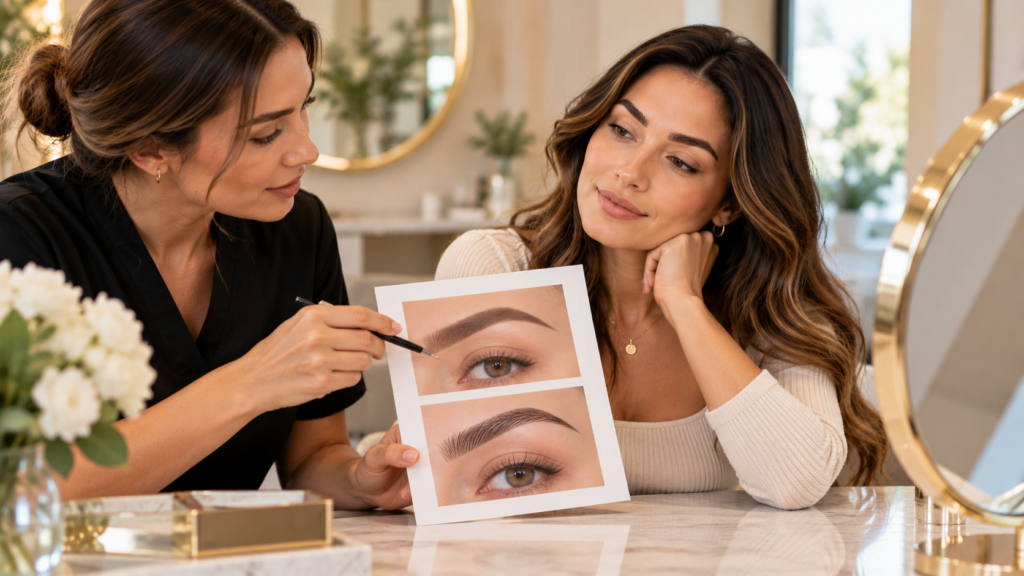
Choosing is easier when you stop asking which is better and start asking which is better for you. Four things usually settle it. Take a few photos of brows you admire, and bring them to your consultation so your artist can see what you are drawn to.
Consider Your Skin Type
- Oily skin: ombre is usually kinder
- Dry or normal skin: microblading shines
- Combination skin: ask about a blend
Consider Your Desired Brow Style
Do you imagine hairs or a soft fill? Your instinct here is almost always right. The finish you picture when you close your eyes is the one you will enjoy living with.
Consider Your Existing Brow Hair
- Lots of hair: microblading adds to it
- Some gaps: either works
- Little hair: ombre usually looks more natural
Consider Your Long-Term Brow Goals
Think about upkeep too. If you want the longest-lasting result with the smoothest fade, ombre tends to be the lower-maintenance path. If you enjoy the idea of a regular refresh and changing your shape over time, microblading offers more room to adjust. A specialist in microblading NYC can walk you through both and show you the likely outcome on your own face.
Can Ombre Brows and Microblading Be Combined?
Yes, and many clients love the result. In a combination approach, hair-like strokes are added at the front and middle of the brow, while soft shading fills in the body and tail. You get the realism of strokes with the density of shading, which suits people who want a natural look with extra fullness. It also works well for people switching between styles. If you have had microblading in the past and now want a softer or fuller look, a shaded layer can often be added over faded strokes. Your artist will look at what remains of the old color before suggesting the best way forward.
Ombre Brows vs. Microblading: Which One Is Right for You?
If you like a soft, polished, makeup-style brow, ombre is likely your match. If you like visible hairs and clean definition, microblading is the one. If you want both, a combination is always on the table. There is no wrong answer, only the right fit for your skin, your brows and your daily routine. The best way to be sure is to sit down with an artist who can see your face in person. The team at Visage New York Studio in Manhattan can help you compare both styles and choose with confidence.